
Domain names are more than just web addresses. They have the potential to tell the story of global connectivity, politics, culture – and crime.
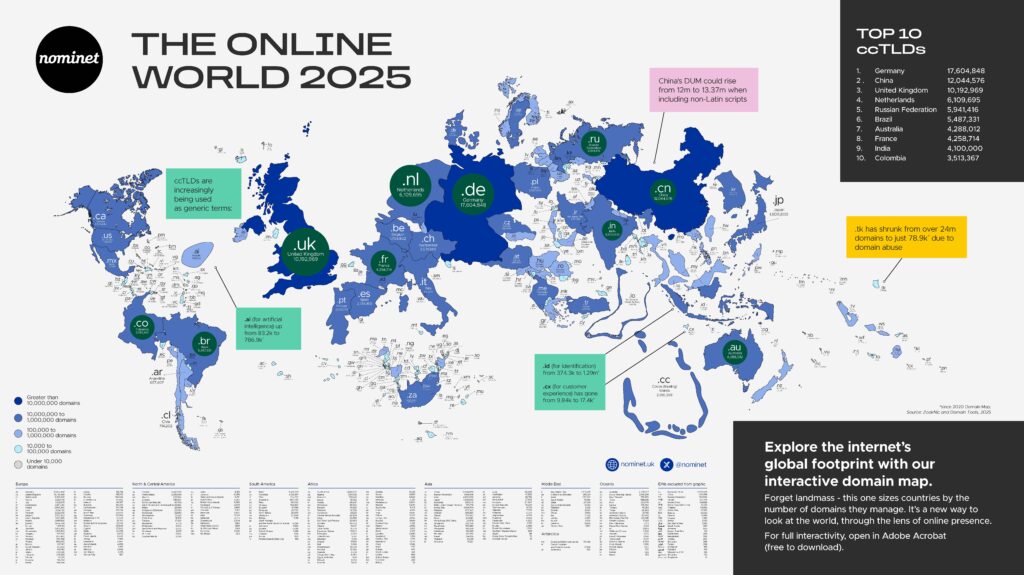
As the guardian of the .UK domain, Nominet keeps a close eye on the changing online landscape to understand our role within it. We create The Online World map, visualising the size and influence of registries like us. This map, available for download, uses each registry’s total Domains Under Management (DUM) to determine the size of the country’s landmass. The result is an interesting geography of the online world measured in DUM.
It’s been a few years since our last map, and the shape of the online world has changed dramatically. And what’s become clear is how Country-Code Top-Level Domains (ccTLD) have become powerful indicators of global digital trends, reflecting everything from geopolitics to innovation.
Join us for a deeper dive into domain name trends, and discover how it shapes a world where technology, geopolitics, language, and culture intersect.
Show me the way to Tokelau
It’s hard to miss one of the biggest changes since our last map, which showed how the Online World looked in 2020. Tokelau’s ccTLD, .tk, has dramatically shrunk, going from dominating the industry with over 24m domains to a comparatively tiny 80k. But why was it so huge to begin with?
Tokelau became an unlikely behemoth because .tk addresses were offered for free. While it made the domain an attractive option for individuals, small businesses, and those in emerging markets who couldn’t afford paid domains, it was a double-edged sword. The Tokelau domain soon became a hotspot for scammers who exploited the endless supply of free domains for phishing, malware distribution, and other malicious activities.
This misuse played a significant role in its decline. In 2024, a staggering 12.6 million domains on TLDs operated by Freenom (.tk, .cf and .gq) were shut down and stopped resolving.
The dramatic drop was a result of a series of events, including a lawsuit by Meta over ignored abuse complaints. Freenom paused new domain registrations in March 2023 and, by February 2024, it announced that it had decided to exit the domain name business, including the operation of registries.
Across the globe, there is an increased focus on combatting abusive registrations and registries are becoming more proactive. At Nominet, we continue to refine our approach to maintaining domain integrity and reducing abuse, which has led to a healthier – and slightly smaller – domain ecosystem. Despite this, the UK continues to punch above its weight, with .UK remaining in the top three with more than 10m registered domains in 2025.
What about the ‘country’ in country codes?
ccTLDs are increasingly being used as generic terms, moving beyond their original country-specific purpose and driving an influx of registrations. Examples include:
- .id (Indonesia) for identification products has jumped from over 370k to around 1.29m DUM
- .ai (Anguilla) used for artificial intelligence is up from over 80k to around 786k DUM
- .cx (Christmas Island) for customer experience has gone from almost 10k to over 17k DUM
This trend is driven by registries trying to sell more domain names by using meaningful two-letter combinations that have broader appeal by making them less restrictive and more attractive to users beyond national boundaries.
However, regardless of registration policies and marketing, two-letter TLDs are sovereign assets tied to their respective countries. Their status reflects the geopolitical stability of their territories, meaning events like border changes, civil wars, and territory transfers can impact a domain’s future.
Geopolitics and domains
Take, for instance, .io – the ccTLD for the British Indian Ocean Territory. In 2020, we had no data on the TLD. But today it has shot up to over 1.1m DUM. Since 1997, the domain, which was assigned to the British-controlled Chagos Islands, has become highly valued for tech and cryptocurrency uses due to its abbreviation for “input/output”. The UK’s recent decision to hand over control over the Chagos Islands as part of a treaty with Mauritius has raised questions about the future of this domain.
By transferring the territory to Mauritius, it could trigger the ISO 3166 process for ccTLD retirement. Mauritius already has its own ccTLD (.mu), so they would need to decide which domain to use. Either way, it’s likely domain holders would not need to transition to an alternative domain, anytime soon, as the retirement process could take 5 to 10 years.
Non-Latin script domains
Using a language that isn’t your own just to access the internet is the reality for millions of people worldwide. Until the introduction of Chinese character domain names, for instance, Chinese users could write everything to access their own websites in their native script – except for the ccTLD. They needed to use Latin characters to type the .cn to access their websites, creating an unnecessary linguistic hurdle.
When factoring in the 6.2m Internationalized Domain Names (IDNs), our map would look a little different. China’s domain count would increase from 10.8 million to around 12.1 million when including its non-Latin script variations. Meanwhile, we have seen the Russian Federation’s Cyrillic ccTLD rise in popularity, increasing by almost 45k DUM since 2020.
We have included the numbers of IDNs in the table here but acknowledge that our graphic today – drawn on a one country, one country code basis for simplicity – cannot convey the complete picture. We are thinking about how best to present the growing presence of internationalised domain names in future graphics.
While it’s hard to predict what the next Online World map will look like, one thing is certain: the domain name landscape will continue to surprise, challenge, and reshape our understanding of digital identity, culture, and global connectivity.
Download The Online World 2025 map.
Source: ZookNic and Domain Tools, 2025
 Back to all blogs