
Earlier this year we announced our first wave of successful DNS Fund applicants. We’re now pleased to share that a further three projects have kicked off. In this blog, we interview Simon Kelley, an individual maintainer of Dnsmasq – and we’ll share more from other projects in the coming weeks.
Open source tool Dnsmasq helps billions of devices get online, from home routers to Android phones, and it’s largely maintained by one person – Simon Kelley. Working from his home office in rural Ireland, Simon is an exemplar of the xkcd cartoon – an unsung hero mostly volunteering his time to keep huge volumes of people connected to the Internet.
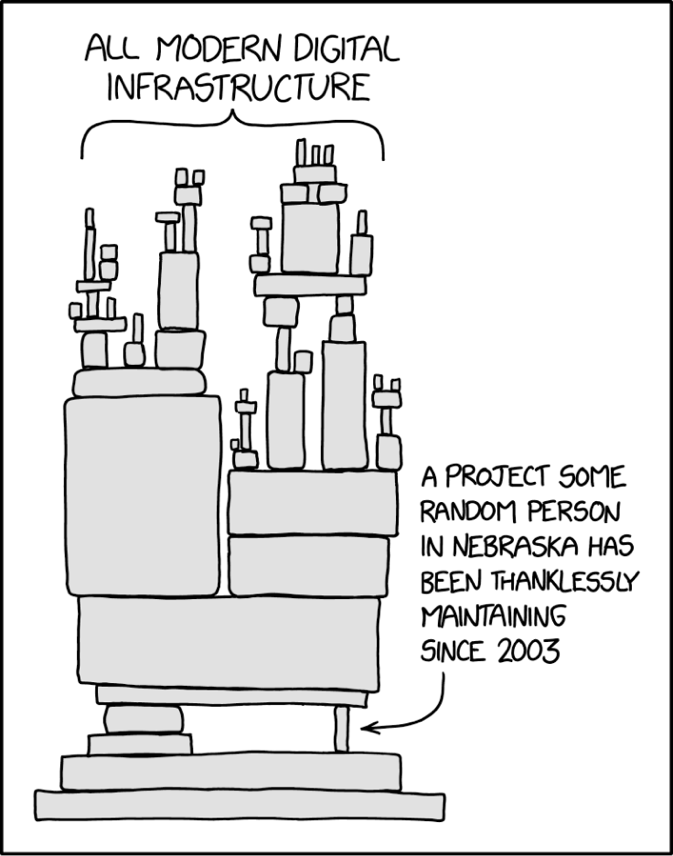
Image source: xkcd cartoon
In this Q&A, Simon explains what his project does, why it matters, how Nominet’s DNS Fund is helping, and why other maintainers should apply.
How did you create Dnsmasq, and when did you realise it had become a big deal?
It started because my internet was annoyingly slow. In the dial-up days, if my connection dropped, my web browser would freeze for ages trying to look things up. I wrote a small bit of software so it would fail quickly instead of hanging. I put Dnsmasq online, other people tried it, and it gradually grew. The “wow” moment for me was discovering Google was using Dnsmasq in Android phones to help with tethering. Realising that an evening project was now running on billions of devices worldwide was really exciting.
What would break if Dnsmasq disappeared tomorrow?
The great thing is that because Dnsmasq is open source, it can’t just vanish. The open-source licence means others can copy and continue the project if I’m not around. But if Dnsmasq magically stopped working everywhere overnight, people would notice. Using your phone as a hotspot would fail on Android. Many home routers would stop handing out Wi-Fi and internet settings properly, so laptops, tablets and smart TVs might not connect. A lot of tech projects that rely on Dnsmasq would struggle to replace it. It’s the kind of tool you’re not meant to notice until suddenly nothing connects.
What are the biggest challenges in maintaining Dnsmasq right now?
The first is AI tools finding security flaws incredibly quickly. That’s good for safety, but it means I get a wave of detailed reports that all need careful checking, and then I need to work on fixes and new releases. I’m a one-person team so there’s always more work than time, such as new ideas, new standards, bug reports, security issues, documentation – it can feel endless. I’m also thinking about eventual retirement, so there’s a question of who takes over and setting Dnsmasq up for the future.
How has support from the Nominet DNS Fund changed what you can do?
The Nominet DNS Fund gives me protected time to do the important but less glamorous work. Instead of only saying yes when a company pays for a shiny new feature, I can focus on making Dnsmasq safer and more robust overall – especially fixing those AI‑discovered security problems. Rather than funding a single upgrade, Nominet’s helping me keep the whole thing healthy and secure.
Why should other open source maintainers consider applying to the DNS Fund?
If you maintain something that keeps the internet ticking, this fund is very relevant. A lot of critical tools aren’t built by big companies. They’re held together by one or two dedicated people. The Nominet DNS Fund recognises that and helps you work on what users really need, rather than shiny new features.
And in terms of the application process, everyone at Nominet was approachable and keen to get it over the line. From my side, it felt like they genuinely wanted to support individual maintainers and they’ve made changes in the process for the next application window so that it’s easier for people like me to apply.
Simon’s story shows what the DNS Fund is all about – giving open source maintainers the time and resources to do the work that keeps the internet working. We’re looking for more projects like Dnsmasq to back. If that sounds like you, we’d encourage you to apply.
The current application window closes on the 17th August 2026.
 Back to all blogs