
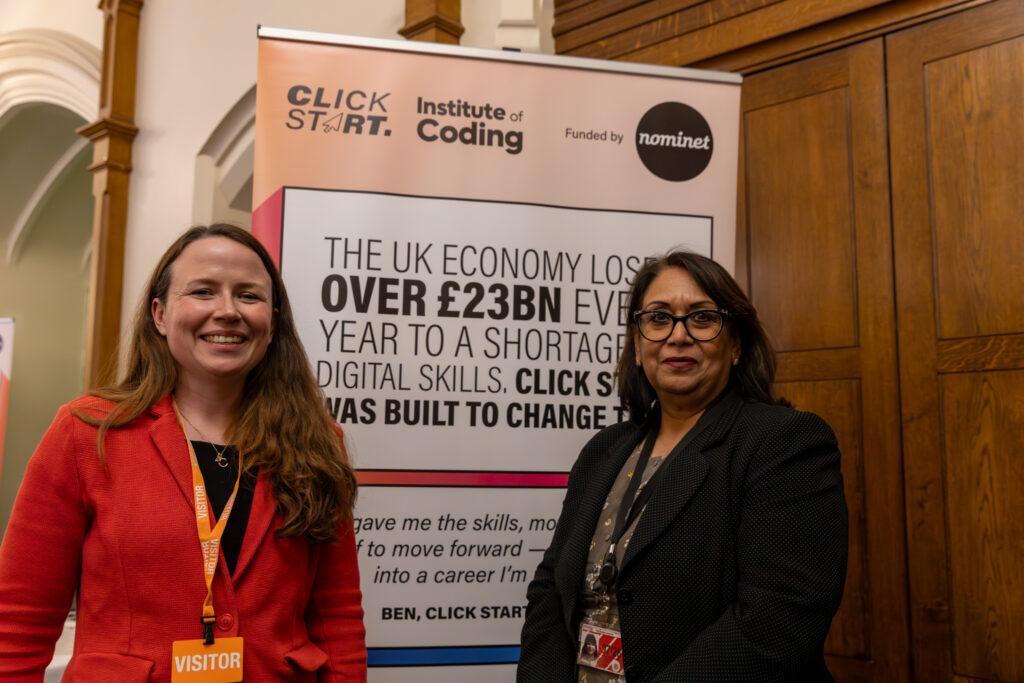
Leaders from education, industry, and government came together at the House of Commons in April 2026 to celebrate the impact of Click Start, a pioneering three-year national programme that helped young people build the digital skills they need to succeed.
Developed by the Institute of Coding and funded by Nominet, Click Start was created in response to a fast-moving job market where digital skills are essential but not equally accessible.
We provided £12 million in funding to bring together universities, employers, and social inclusion organisations at a national scale for the first time, to tackle this issue. The event marked the end of the programme, which has supported almost 40,000 learners, with 10,000 course completions, helped nearly 1,000 people move into jobs or further study.
Bringing partners, learners and policymakers into one room brought the programme’s impact to life and sparked important conversations about what the UK could do next to close the digital skills gap.
Dan Aldridge MP for Weston-Super-Mare hosted the event and spoke about the urgent need for a stronger, more ethical professional voice in tech to safeguard the sector’s future. He encouraged attendees to change this by emailing their MPs, submitting evidence to select committees and holding politicians to account. He also highlighted how programmes like Click Start aren’t just a “nice to have” – they show how the UK can deliver digital skills and tech policy that deliver results. Events like the celebration at the Houses of Commons, he said, create a “psychological dotted line” between grassroots programmes and Westminster, and it’s up to everyone involved to use that connection so their real-world experience shapes the UK’s digital future.
Our CEO, Paul Fletcher, spoke about the human impact of the UK’s digital skills gap and the opportunity it represents. As guardians of the .UK domain and a tech employer, Nominet sees a mismatch: a million young people who “want to work” but lack access to opportunities, and employers struggling to find talent – a gap Paul quoted as being worth £23 billion a year to the UK economy. Click Start was created to help close this gap by bringing together universities, charities and employers in what he described as the programme’s “magic” – strong local delivery and genuine partnership.
The impact was clear in the room. Learners shared how the programme has boosted their confidence, opened doors and changed their future paths – stories captured in a film shown at the event.
A central theme of the event was the recognition that traditional approaches to digital skills training are not suited to everyone. Professor Sue Black brought this to life through her reflections on TechUP Women, a programme delivered in partnership with Catch22 and Durham University. Designed specifically for women and non-binary learners, groups historically underrepresented in the technology sector, the programme demonstrated the importance of tailoring provision to meet the needs of different communities.
In conversation with learners Molly and Grace, this discussion highlighted how confidence building, peer support, and accessible learning environments were just as important as technical training. The learners’ experiences made it clear that when individuals feel that they belong, they are far more likely to succeed.
Jean Duprez MBE from Be the Business felt that employers had an important role to play, when sharing insights from a partnership with the University of East London. This work focused on supporting small and medium-sized enterprises, which are a vital part of the UK economy but often face challenges in accessing digital talent. Through Click Start, the partnership was able to better align training with employer needs and create clearer pathways into work.
In his closing remarks, Professor Rachid Hourizi MBE – leader of the Institute of Coding -reflected on the broader significance of what had been achieved by Click Start. He highlighted collective effort behind the programme, which he described as a the “coalition of the willing” – Nominet’s funding and personal commitment, and a national network of universities, charities and community organisations who were trusted to do what they do best.
At the same time, Rachid acknowledged that the context in which the programme operated constantly changed. Advances in technology, including the growing influence of artificial intelligence, are reshaping entry-level roles and altering the skills that young people need to succeed.
As the event concluded there was a shared sense that Click Start had changed lives, provided important learning for the future, and unlocked talent that might otherwise be overlooked. Now, the challenge is to build on its foundation and ensure that even more young people, regardless of their background, have the opportunity to thrive in the digital economy.
Explore more about our projects with Click Start in our other blogs:



 Back to all blogs